Terradigm Blueprint
Nature-Informed Strategies for Systems Transformation
Executive Summary
A high-level overview of the project’s key insights and strategies, suitable for diverse stakeholders.
Challenge or Opportunity
Public schools in the United States move every student through the same material on the same timeline, whatever their readiness. That rigid, linear model leaves teachers exhausted and students disengaged. It gives educators no room to respond to local needs such as language barriers and literacy gaps, and it strips them of the professional autonomy to adapt.
Vision
Students know the learning targets from the start and move toward them at their own pace. Gaps are caught while they are still small. Help comes from many directions, including other students. Teachers have the time and latitude to notice what is happening and change course, and students take on real roles as leaders and teachers of one another.
Operating Context
Current Assessment
Non-negotiables
Standards-based curriculum targets and standardized assessments remain in place. The school’s bell schedule is fixed. Any change must be within the authority of an individual teacher or a preparation program to begin.
System Boundaries
This addresses teacher preparation and classroom practice. District policy, administrative mandates, school funding, teacher pay, and staffing levels are outside its scope, though its ideas are designed to help educators build the case for the freedom they need.
Primary and Secondary Functions
Design PrinciplesPrimary function
Application IdeasPrimary function
Multi-Functional Application Ideas
Table of Contents
Challenge or Opportunity
The core challenge or opportunity being addressed, explored in greater depth than in the Executive Summary.
This is the challenge as you described it, restated in your own words wherever possible, so the research remained grounded in what actually brought you here.
The United States public education system is currently navigating a systemic crisis characterized by rigid, linear learning models that prioritize standardized curriculum goals over individual student readiness. This mechanical approach to knowledge transfer has created a brittle environment where teacher burnout and student exhaustion are prevalent. By forcing diverse learners into identical timelines and restrictive schedules, the current system fails to account for local challenges such as language barriers and literacy needs, ultimately stripping educators of the professional autonomy required to innovate or adapt to their specific classroom dynamics.
Vision
A clear picture of what success or flourishing looks like, in more depth than the Executive Summary.
This is how you’ll know the work is working. Use it to check any Design Principle or Application Idea against what you’re actually trying to achieve.
Desired Outcomes
Students know the curriculum guidelines and targets from the start and organize their own way through the learning, moving at a pace that gives ideas time to take hold. They pursue their interests within a few clear parameters, work on real problems, and take on varied roles, including teaching classmates who need support. Teachers have the time and space to respond when something changes, whether half the class stalls on a concept or a language barrier appears, without giving up other instructional time. They work alongside colleagues in shared classrooms and across subjects, with roles that overlap and shift. The community comes into the school, and students go out into the community.
You will know the system is working when:
Operating Context
The real-world conditions the system must work within, in more depth than the Executive Summary.
Context determines which strategies will actually succeed. This section captures the specific conditions your system operates in, so the strategies that follow are matched to reality, not offered in the abstract.
Constraints and Boundaries
The essential limits, non-negotiables, and scope for the work, in more depth than the Executive Summary.
Every Design Principle and Application Idea in this Terradigm Blueprint has been developed with these limits in mind. Nothing offered here should ask you to cross a boundary you’ve already named.
Non-negotiables
System Boundaries
Key Stakeholders and Relationships
The key stakeholders and relationships that influence what is possible.
The Design Principles and Application Ideas in this Terradigm Blueprint were developed with these relationships in mind.
Nature-informed design starts with function. Before we can find the right biological and ecological models, we have to know precisely what your system needs to do. That’s what the functions below represent: your challenge, translated into the specific actions the solution must perform, so we can learn from the organisms and ecosystems that have already solved the same kind of problem.
Primary and Secondary Functions
Your challenge translated into the distinct functional needs your system must meet. One is identified as the primary function: the need most critical to unlocking the challenge. The others are secondary functions, separate needs that also matter to the system. They are secondary because they are less central to unlocking the challenge, not because they are extensions of the primary function.
All functions are researched with equal rigor. Each function, primary and secondary, gets its own Design Principles and Application Ideas later in this document.
Coordinate independently paced activity across a group toward shared targets
Design Principles
The recurring strategies nature uses to solve the same kind of challenge you’re facing, translated into design guidance you can act on.
Design Principles are organized by function, starting with your primary function, followed by secondary functions.
Each function includes three prioritized Design Principles:
- Highest-Fit Move - The strategy most precisely matched to the primary functional need and context.
- Highest-Leverage Move - The strategy positioned to create the greatest ripple effect or systemic impact.
- Entry-Point Move - The strategy offering the most accessible or lowest-barrier starting point for action.
Each Design Principle includes one Biological Champion whose adaptive strategy and enabling mechanism illustrate how the corresponding functional need is met in nature. The Design Principles themselves are derived from patterns identified across research into 200+ biological examples, so each Biological Champion represents just one example among many organisms and systems expressing that same underlying strategy. The complete set of Design Principles, including any not shown here, appears in Appendix D.
Coordinate independently paced activity across a group toward shared targets
Let the Classroom Environment Carry the Instructions
Coordinate many students and teachers by embedding task progress, priorities, and next steps into visible, shared artifacts in the learning environment—so the space itself communicates what needs to happen next.
Nested Teams That Can Split and Recombine
Scale coordination by organizing a large group into nested, semi-autonomous teams that synchronize internally, coordinate across teams through representatives, and split or merge when priorities or resources demand it.
Synchronized Timing Through Shared Pulses, Not Central Clocks
Synchronize timing across many distributed participants using internal rhythms coupled by brief, shared signals and built-in recovery periods that prevent runaway chain reactions.
Repair small deviations before they compound
Seal First, Rebuild Later—Staged Repair in Sequence
Prevent damage from escalating while maintaining function by rapidly containing the breach, then executing localized remove-and-rebuild cycles guided by real-time feedback from the affected area.
Self-Correcting Identity Through Continuous Local Feedback
Maintain robust roles and spatial organization under disruption by continuously reading local context cues and relaxing disturbances back to stable, healthy patterns.
Tipping Points That Trigger Collective Action
Trigger coordinated group-wide shifts only when enough local participation or density makes collective action worthwhile, using clear thresholds and self-reinforcing momentum.
Distribute support demand across the group
Gradual Recruitment with Built-In Overflow Protection
Scale participation smoothly and prevent burnout or overload by combining varied readiness levels, real-time feedback from bottlenecks, reserve capacity, and crowding limits that redirect effort.
Strengthen What's Used, Let Go of What Isn't
Allow the most effective routines, pathways, and practices to self-reinforce through regular use, while underused alternatives naturally fade—keeping the system adaptive rather than locked in.
Purpose-Built Spaces That Sense and Adjust to Local Conditions
Reduce interference between activities and tune local work rates by partitioning space into purpose-specific zones and adjusting the physical environment in response to locally sensed conditions.
Transmit skills from experienced to less experienced members
Mentorship Pathways and Convergence Points for Knowledge Transfer
Improve group performance by channeling high-stakes decisions through experienced members and by creating predictable gathering points where knowledge spreads efficiently to newcomers.
Shared Decision-Making Through Local Awareness and Weighted Influence
Reach coherent group decisions and coordinated action by combining awareness of nearby peers, persistence of commitment, experience-weighted influence, and self-correcting feedback from spacing and pacing.
Smart Switching Between Independent Exploration and Learning from Others
Allocate attention to peer learning only when it genuinely helps, switching between independent exploration and observing others based on task difficulty and the reliability of who you're learning from.
Application Ideas
Concrete examples of how the Design Principles above could show up in your context. They are meant to spark ideas and accelerate experimentation, not prescribe a solution. Each one offers a plausible way a Design Principle could take shape in your context, written concretely enough to picture, question, adapt, or reject.
Treat them as starting material.
Application Ideas show what each Design Principle could look like in practice. Each one is a concrete expression of a Design Principle already identified and prioritized above, rather than a new or separate recommendation.
The Application Ideas correspond directly to the prioritized Design Principles:
- Highest-Fit Move - The strategy most precisely matched to the primary functional need and context.
- Highest-Leverage Move - The strategy positioned to create the greatest ripple effect or systemic impact.
- Entry-Point Move - The strategy offering the most accessible or lowest-barrier starting point for action.
Design Principles capture the essential elements of the strategy and must be applied in full. Each Application Idea should reflect the complete Design Principle, not a partial version of it. Treat each one like a precise recipe: follow the full logic, with no shortcuts, substitutions, or selective use of individual elements. The application itself can change, so long as the Design Principle it is built on remains intact.
Additional Application Ideas appear in Appendix D.
Coordinate independently paced activity across a group toward shared targets
The Classroom Studio Board: Making Student Progress Visible Without Constant Check-Ins
Transform your classroom into a shared workspace where task progress, priorities, and help-needs are tracked through simple visual cues on a wall board—reducing the need for constant teacher broadcasting while keeping the system honest through lightweight evidence checks, timed updates, and quick spot-checks.
Flexible Learning Pods: Structured Autonomy That Administrators Can See
Reorganize classes into stable small-group pods that can merge during pre-approved collaboration windows—supporting student autonomy and co-teaching while meeting supervision, predictability, and equity requirements.
A Pulse Schedule for the Class Period
Each work block is divided into protected stretches of independent work separated by short check-ins the whole class shares, so students keep their own pace while the room stays aligned.
Repair small deviations before they compound
The Learning Repair System: Triage, Seal, Rebuild, Refer—With Student-Owned Formative Data
Prevent learning gaps from compounding by using a tiered repair system—fast in-class fixes for small errors, scheduled rebuild clinics for moderate gaps, and clear referral pathways for deep deficits—supported by ethical, formative, student-owned diagnostic checks.
Placement by Current Evidence
Each student's standing is read fresh from current work against posted targets and exemplars, replacing fixed tier labels, and students use the same references to correct their own course.
Whole-Class Shift Moments
When a set number of students stall on the same step, the whole class switches briefly into a targeted mini-lesson, then returns to independent work once the need has passed.
Distribute support demand across the group
Rotating Peer Coaches: Structured Student Support Without Teacher Bottlenecks
Replace the teacher-as-sole-helper model with a structured peer support system where students earn temporary, skill-specific coaching roles—while preventing status hierarchies through rotation, private help channels, opt-out protections, and built-in accuracy checks.
Help Routes That Earn Their Place
Support options that students use, and that work, gain time and space. Unused ones are retired on a set schedule, and one or two stay in reserve for needs that return.
A Room Zoned for the Work
The room is divided into zones for independent work, peer help, conferencing, and reteaching, and the layout shifts in response to noise, crowding, and the length of the help queue.
Transmit skills from experienced to less experienced members
Guided Pairs and Regular Gathering Points
Students who clear a checkpoint guide one classmate through it at the follower's pace, and regular gatherings let students and teachers watch approaches that worked and adopt them.
Letting Experience Steer the Group
Members who have mastered a step carry more weight in setting a group's approach, hold that approach long enough for others to learn it, and regroup when progress spreads too far apart.
Persist or Ask
A posted two-question rule tells students when to keep working alone and when to learn from a classmate who has already cleared the step.
Multi-Functional Application Ideas
Nature relies heavily on multifunctional design. The same structure, relationship, or strategy often meets several needs at once. This section reflects that same pattern: applications built by combining lessons from two or more of your functions, where the underlying biology and design principles genuinely reinforce themselves. Their value lies less in outscoring a single function’s own top three, and more in addressing several needs at once through one integrated design move.
Up to three Multi-Functional Applications are included here. If no Multi-Functional Applications appear below, it means the research for this Terradigm did not surface a combination strong enough to meet our evidentiary standard. We’d rather tell you that clearly than offer you a weak or speculative multi-functional idea.
The Board That Calls for Help
Requests for help posted on the progress board bring peer coaches into the work in stages as demand rises, with limits that keep any one helper from being overwhelmed. It joins The Classroom Studio Board and Rotating Peer Coaches into a single system, so the board itself decides how much help is running at any moment.
Pods That Follow Experience
Small groups split and merge as students' progress diverges, and members who have mastered the relevant step carry more weight in setting the group's direction. It joins Flexible Learning Pods and Letting Experience Steer the Group into a single system, so group size and leadership shift together with where students are in the work.
Implementation
The suggested steps to put into practice each Application Idea shown in the body of this report.
The Classroom Studio Board: Making Student Progress Visible Without Constant Check-Ins
Flexible Learning Pods: Structured Autonomy That Administrators Can See
A Pulse Schedule for the Class Period
The Learning Repair System: Triage, Seal, Rebuild, Refer—With Student-Owned Formative Data
Placement by Current Evidence
Whole-Class Shift Moments
Rotating Peer Coaches: Structured Student Support Without Teacher Bottlenecks
Help Routes That Earn Their Place
A Room Zoned for the Work
Guided Pairs and Regular Gathering Points
Letting Experience Steer the Group
Persist or Ask
The Board That Calls for Help
Pods That Follow Experience
Evaluation using Life’s Principles*
Life’s Principles are a set of ubiquitous patterns found across all living systems. Because of this, they can serve as universal standards for assessing the effectiveness and long-term viability of a design. Throughout this section, “your system” refers to the system described in your Operating Context above. Keep that same scale in view as you work through the questions.
Life’s Principles can be used in two ways: as aspirational goals to guide what you build, and as evaluation lenses to assess whether your design is becoming more resilient, adaptive, and life-conducive over time.
Below, each Life’s Principle is paired with a set of reflection questions. If there is sufficient time and interest, work through these questions with key stakeholders before integrating the design principles and strategy ideas from your Terradigm Blueprint. This will give you a baseline for understanding the current state of your system. Revisit the questions in three to six months to assess what has shifted and why. If a baseline assessment is not feasible now, set a date to return to these questions after you have begun implementing your Terradigm strategies. Whenever you engage with the Life’s Principles, they can offer valuable insight into how your system is functioning and changing over time.
A standalone version of this evaluation is available free at terradigm.org as the Life’s Principles Audit, formatted for printing and easy to use with a group.
Evolve to Survive
Evolve to Survive means continually incorporating and embodying information to ensure enduring performance. It achieves this by repeating approaches that have demonstrated success; using mistakes to generate new forms or functions; and recombining and modifying information to produce new possibilities.
Reflection questionsHow does your system continuously integrate information in ways that support its lasting performance?
aHow does your system repeat the approaches that have demonstrated success?bHow does your system use mistakes to generate new forms or functions?cHow does your system recombine and modify information to produce new possibilities?What’s working wellWhat is your system already doing here that’s worth continuing or building on?What could improveWhere is your system missing chances to evolve based on what’s happened or through new information?Adapt to Changing Conditions
Adapt to Changing Conditions means appropriately responding to dynamic contexts. It achieves this by using varied forms, processes, and systems to effectively engage with its external context; continually investing energy and matter to heal, sustain, and improve the system; and preserving function after disruption through variation, redundancy, and decentralization.
Reflection questionsHow does your system adjust appropriately as conditions change?
aHow does your system use varied forms, processes, and systems to effectively engage with its external context?bHow does your system continually invest energy and matter to heal, sustain, and improve itself?cHow does your system preserve function after disruption through variation, redundancy, and decentralization?What’s working wellWhat is your system already doing well to adapt to changing conditions?What could improveWhere does your system struggle to adapt and adjust? What is currently too rigid, and where could greater flexibility benefit the system?Be Locally Attuned and Responsive
Be Locally Attuned and Responsive means fitting into and integrating with the surrounding environment. It achieves this by leveraging recurring phenomena and processes; building with materials that are abundant and accessible while drawing on freely available energy; creating mutual benefit through win-win interactions; and using recurring information flows to adjust a response appropriately.
Reflection questionsHow does your system operate in ways that fit within and are integrated with its immediate local context?
aHow does your system leverage recurring phenomena and processes?bHow does your system build with materials that are abundant and accessible, while drawing on freely available energy?cHow does your system create mutual benefit through win-win interactions and partnerships?dHow does your system use recurring information flows to adjust its response appropriately?What’s working wellWhat is your system already doing well to fit within and respond to its context?What could improveWhere is your system disconnected from its context, or not harnessing what is already available to it?Integrate Development with Growth
Integrate Development with Growth means balancing investments to move toward an enriched system. It achieves this by creating conditions that enable components to interact with one another and the local context; constructing the system one unit at a time; and organizing modular units within larger units to build increasing complexity.
Reflection questionsHow does your system balance investment in growth with investment in strengthening and enriching itself?
aHow does your system create the conditions that enable its components to interact with one another and the local context?bHow does your system construct itself one unit at a time?cHow does your system organize modular units within larger units to build increasing complexity?What’s working wellWhat is your system already doing well to balance development with growth?What could improveWhere does your system need to recalibrate resources in order to create a better balance between development and growth?Be Resourceful with Material and Energy
Be Resourceful with Material and Energy means optimizing the use of resources and taking advantage of opportunities. It achieves this by shaping structures and patterns according to the function they need to perform; designing solutions that meet multiple needs at once; achieving the needed performance with minimal energy by taking advantage of conditions that reduce energy demand; and keeping resources circulating through connected flows so they remain available for reuse.
Reflection questionsHow does your system optimize its use of materials and energy while harnessing opportunities?
aHow does your system shape its structures and patterns according to the function they need to perform?bHow does your system design solutions that meet multiple needs at once?cHow does your system achieve the needed performance with minimal energy, by taking advantage of conditions that reduce energy demand?dHow does your system keep resources circulating through connected flows so they remain available for reuse?What’s working wellWhat is your system already doing well in how it uses resources and takes advantage of opportunities?What could improveWhere is your system using more resources than necessary, or failing to make full use of resources already available?Use Life-Friendly Chemistry (shown for completeness)
Use Life-Friendly Chemistry means using materials and processes that support life’s systems at all scales. This principle is part of the full Life’s Principles canon but applies to material, product, and chemical design rather than the human systems work Terradigm focuses on. It is included here for reference, not as an active part of this audit.
* Life’s Principles were developed by Biomimicry 3.8
Closing Synthesis
Looking over this Life’s Principles evaluation, identify which Life’s Principle you believe will provide the most benefit to your system if you invested in it now, and one immediate step you can take to begin that work.
Biological Champions
Sample AppendixThis sample shows the Biological Champions associated with the Design Principles presented in the body of this sample report. Each entry includes the organism’s common and scientific names, along with the strategy and mechanism it uses to meet the relevant functional need. A completed Terradigm Blueprint includes additional Design Principles beyond those shown in the body of this sample, and Appendix A includes the Biological Champion associated with every Design Principle in the full Terradigm Blueprint. The supporting biological research and citations are included in Appendix B.
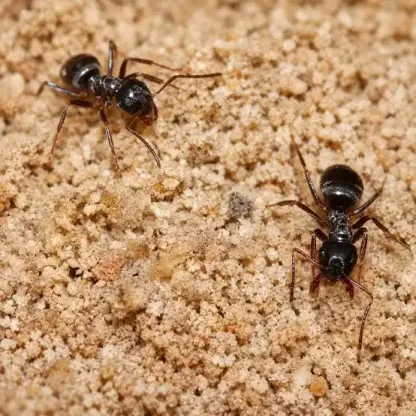 Black garden antLasius nigerStrategy: Black garden ants coordinate nest building by letting the work already done tell each worker where to add material next.Mechanism: Each worker leaves soil laced with a chemical signal that draws more deposits to the same spot, so small starting points grow into pillars and walls, while the signal fades over time so that abandoned spots stop attracting workers.
 Guinea baboonPapio papioStrategy: Guinea baboons organize a large society into small, stable units nested inside larger groups, so the society can move as a whole or travel in its smaller units.Mechanism: Each unit of one breeding male with several females and their young joins with other units to form a party, parties come together into gangs of up to about 200 animals, and group departures can involve a single unit, several units, or a whole party, with both males and females able to start a departure that others follow.
 Social amoebaDictyostelium discoideumStrategy: Social amoebas bring many separate cells into a shared rhythm by passing brief chemical pulses from neighbor to neighbor, with no central timekeeper.Mechanism: Each cell keeps its own rhythm and periodically releases a chemical pulse, neighbors that detect the pulse reset their own rhythm to match, and a recovery period after each pulse keeps the signal from re-triggering, producing waves that travel outward and repeat about every five to ten minutes.
 MammalsMammaliaStrategy: Mammals repair damage in two stages, closing a wound quickly to restore a protective barrier and then rebuilding strength slowly, one small section at a time.Mechanism: Skin seals a wound early to limit fluid loss and infection before slower reconstruction begins, and bone is repaired by small mobile teams in which removal cells clear damaged material and builder cells follow behind to lay down new material, concentrating on areas under the most stress so that only a small area is weakened at any time.
 Thale cressArabidopsis thalianaStrategy: Thale cress keeps its growing tissues organized by having each cell read its role from the signals around it, so roles can change when a cell's surroundings change.Mechanism: When damage or an irregular cell division moves a root cell into a new position, the cell switches on the genes that match the signals at that position, and in the growing shoot tip, a destroyed control center is rebuilt within one to two days through a feedback loop in which one signal promotes the center and triggers a second signal that limits its size.
 African wild dogLycaon pictusStrategy: African wild dog packs move off together only after enough members have signaled readiness.Mechanism: During a high-energy greeting rally before the pack moves, dogs make short sneezes that work as votes, and the pack departs once the sneezes pass a threshold of about three when a dominant dog starts the rally and about ten when a lower-ranking dog does.
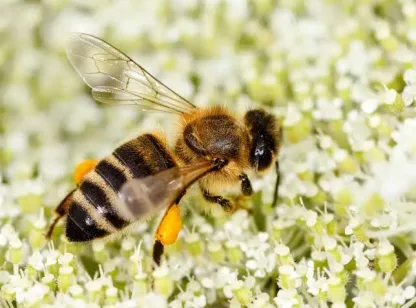 Western honey beeApis melliferaStrategy: Honeybee colonies add foragers gradually as demand grows and slow recruitment on their own when the hive cannot keep up.Mechanism: Each bee takes up a task only when the local need passes its own personal threshold, and because thresholds differ from bee to bee, workers join a few at a time, while foragers who must wait too long for a receiver bee to take their nectar dance less to recruit others, slowing the inflow until processing catches up.
 Argentine antLinepithema humileStrategy: Argentine ants keep their trail networks matched to where food is best by adding trails where traffic is heavy and dropping trails where it is light.Mechanism: Foragers lay chemical trails as they travel, colonies build extra trails to the richest food sources, lower-traffic trails are gradually pruned from the network, and ants switch to alternative paths when a route is blocked.
 Leaf-cutter antAtta vollenweideriStrategy: Leaf-cutter ants divide their nests into chambers for different kinds of work and reshape the nest in response to conditions they sense inside it.Mechanism: Fungus gardens and waste are kept in separate chambers so work in one does not contaminate another, and the ventilation turrets workers build on the nest change their structure, including how many openings they have, in response to carbon dioxide levels in the tunnels below.
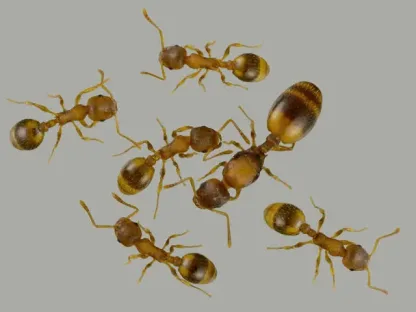 Acorn antTemnothorax nylanderiStrategy: Acorn ants pass knowledge from an experienced ant to a newcomer one pair at a time, and the newcomer then passes it on.Mechanism: In tandem running, the follower keeps touching the leader's legs and body as they walk, the leader waits when contact is lost, and followers learn the route itself, which most of them later use when they lead tandem runs of their own.
 Olive baboonPapio anubisStrategy: Olive baboon troops decide where to go through a shared process in which no single animal, dominant or not, controls the outcome.Mechanism: A baboon that moves off is more likely to be followed when several others head the same way and returns if no one follows, and when two directions compete, the troop meets in the middle if they are close together and picks one if they are far apart.
 Barbary macaqueMacaca sylvanusStrategy: Barbary macaques learn from others mainly when a task is too hard to work out alone, and then copy the most successful group-mate they have watched.Mechanism: When free-ranging macaques were given new foraging tasks, techniques spread from one animal to another only for the hardest tasks, passing along close, tolerant relationships and between animals that had watched each other, and on the hardest task, individuals appeared to copy the most successful demonstrator they had observed.
Primary Literature
Sample AppendixThis sample shows a partial selection of the primary literature supporting the biological examples, strategies, mechanisms, and Design Principles presented in this sample report. A completed Terradigm Blueprint includes additional Design Principles and Biological Champions beyond those shown here, and Appendix B includes the full set of research citations used throughout the Terradigm Blueprint.
Full Tangled-Tree Visualization
The complete lineage from functions through Design Principles to Application Ideas, in an interactive, clickable format.
The visuals shown earlier in this document are pieces of this larger visualization. Here, you can see the whole picture in one place. Click on different elements of the diagram to explore specific connections and relationships.
Complete Set of Design Principles and Application Ideas
Every Design Principle and Application Idea generated for this Terradigm Blueprint, including those already shown in the body of the report.
The body of this document shows only each function’s top three Design Principles and their corresponding Application Ideas, prioritized to keep the core findings clear and usable rather than overwhelming. This is the full set of nature’s lessons for your challenge, organized the same way as the body: by primary function first, followed by each secondary function, with each Design Principle paired directly with its Application Ideas.
Terradigm Blueprint|Adaptive Learning Ecosystem